
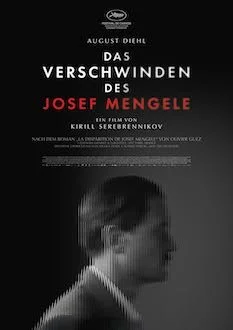
Direction: Kirill Serebrennikov
Country: Germany / France / other
Russian filmmaker Kirill Serebrennikov (The Student, 2016; Petrov’s Flu, 2021) turns his gaze to Josef Mengele—the Auschwitz doctor infamously known as “The Angel of Death”—in his latest historical drama The Disappearance of Josef Mengele. Based on Olivier Guez’s non-fiction novel, the film traces Mengele’s later years as he evades capture under false identities in Buenos Aires, Paraguay, and Brazil. Magnificently embodied by August Diehl, the fugitive doctor receives a clandestine visit from his son, Rolf (), yet remains unrepentant, clinging to his ideological convictions until the end.
This is a deeply disturbing work that seeks not compassion but clarity, with Serebrennikov adopting an oppressive visual language shaped by extended takes, stark black-and-white imagery, tense legato scoring, and disorienting shifts in time and space. Departing from his usual formal lyricism, the director presents a remorseless figure haunted by the specters of his past with simmering intensity. At times chaotic—particularly in the inclusion of 8mm color sequences depicting the atrocities committed by Mengele and his collaborators—the film nonetheless reveals a cold, austere beauty in its portrayal of physical decay, mental deterioration, and ultimate isolation.
Though it might benefit from a tighter runtime, The Disappearance of Josef Mengele—sometimes unbearable, sometimes virtuosic—leaves a powerful, disorienting impression.

