
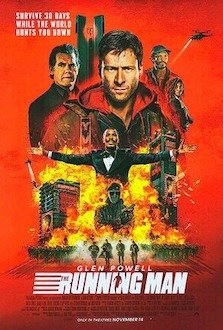
The Running Man (2025)

Direction: Edgar Wright
Country: UK

British filmmaker Edgar Wright, who made his name with cult favorites such as Shaun of the Dead (2004), Hot Fuzz (2007), and Baby Driver (2017), returns with The Running Man, an effusive sci-fi action thriller based on Stephen King’s novel and adapted for the screen for a second time, following Paul Michael Glaser’s 1987 version. Glen Powell takes over Schwarzenegger's role in this weakened satire, which plays less like a cautionary dystopia and more like a garish circus broadcast in real time.

Powell stars as Ben Richards, an honest yet volatile man caught in a family crisis, recently fired for insubordination and deeply distrustful of the system and its rules. Desperate, he signs up for the wildly popular TV show The Running Man, a dangerous, often barbaric, technology-manipulated game of survival run by sadistic producer Dan Killian (Josh Brolin).

Although it gestures toward revolution and rebellion, The Running Man never feels grounded or serious, instead pushing forced ideas and piling on far-fetched action sequences. It can be mildly entertaining in spurts, yet it feels as artificial as the fictional program it depicts, constantly echoing better films without forging a strong identity of its own. Don’t let the hype mislead you: this is a slick pretender, driven by formulaic plotting and an aggressive posture, unable to connect its excesses to anything resembling a plausible reality.

Burdened by what feels like heavy post-production interference, the film struggles to find a stable rhythm, repeatedly tripping over its own noisy boom-crash-bang theatrics and a shaky script. Had Wright opted for greater simplicity and fewer preposterous action set pieces, the result might have been a leaner, more coherent spectacle. As it stands, The Running Man is cluttered with loose ends and strained credibility. Check out for yourself and see if you can forgive its flaws.

Last Night in Soho (2021)

Direction: Edgar Wright
Country: UK 

British writer-director Edgar Wright, known for his penchant for genre hybridity, delivers a ghostly, psychological horror film with the indomitable energy, fast pacing and dark tones that characterized some of his memorable comedies (Shaun of the Dead; The World’s End). 

You might choose to go with his beat here, which, by the way, is from the 60s in terms of soundtrack and looks - but the plot is purposely convoluted with occasionally forced twists and false hints that only serve to mystify the audiences. Last Night in Soho, his seventh fictional film, has an auspicious start but is later turned into repetition, just to definitely trip and get lost in the unfathomable, obscure last third, where the narrative is sacrificed for hasty sensationalist tactics.

The story follows the young Eloise Turner (Thomasin McKenzie), who leaves the English countryside to go to London and pursue her dream of becoming a fashion designer. Eloise possesses a sixth sense, often seeing her late mother, who died when she was seven. In London, she first stays in the school’s dorm but falls victim to the derisive commentaries and late parties of her roommate. Wishing peace and quiet, she rents a room for herself in an old house owned by Ms. Collins (the late Diana Rigg). That’s when she starts having vivid dreams with Sandie (Anya Taylor-Joy), an aspiring singer in the 60s, as well as creepy visions of that time. Figures from the past and present get often blurred in her head. 

This flawed horror-movie pastiche with references to the zombie and giallo canons is no novelty but can still provide some fun for those in the right mood.

Baby Driver (2017)

Directed by Edgar Wright
Country: USA / UK

British cineaste Edgar Wright has one of those creative minds that you always expect a lot from. He traditionally delivers bold and nimble stories whose course of events suit tastes of both young and old generations. His filmography might not be so extensive, but includes a trio of mandatory flicks, in which he masterfully blended action and comedy genres, gaining deserved praise and a legion of followers around the world. They are “Shaun of the Dead” and “Hot Fuzz”, two masterpieces, and also the extremely entertaining “The World’s End”. Only “Scott Pilgrim vs. the World” didn't work for me, feeling like the weakest link.

His new film, an American crime adventure entitled “Baby Driver”, seemed to be the right spin his career needed. Yet, the enthusiasts of his previous movies won’t find that outstanding, sparkling humor but rather considerable amounts of tense activity packed with adrenaline. 

Set in Atlanta, Georgia, the story focuses on Baby (Ansel Elgort), an orphan young man with a baby-face and phenomenal driving skills, who is also a music lover. Music is an indispensable factor in his life since it eases his tinnitus symptom, making him even bolder behind the wheel.

Traumatized by the accident that victimized their parents, Baby has been working as a driver for a crime boss, Doc (Kevin Spacey), who uses him for violent heists. At first, his collaboration served to pay for having stolen one of the Doc’s cars, but when one last job is not proposed but required, it becomes a totally different story.

Boasting a confident personality, Baby embraces the task with his habitual coolness while his nonchalant posture arises some suspicion in the thugs hired by Doc – “you cannot just being in crime without being a little criminal”, one of them said.

Only one aspect makes him ponder about the uncomfortable situation he got himself into. It’s his other half, Debora (Lily James), a deli waitress with an enchanting voice who also vibrates with music.

“Baby Drive”, a stylish combination of Winding-Refn’s “Drive” and Affleck’s “The Town”, runs at a hurried yet safe speed as it flourishes with a diversified pop/rock soundtrack in the background. 
If Spacey accomplishes his role in a sober performance, the young Elgort (“The Fault in Our Stars”) jumps to the spotlight, showing he’s ready for even bigger challenges.

Mr. Wright mounted his plot with a peculiarly interesting character in the center, but when it comes to the conclusion, he was a bit of a letdown. Unfortunately, the justice doesn’t have so much consideration for sly little criminals in the guise of good Samaritans.
