
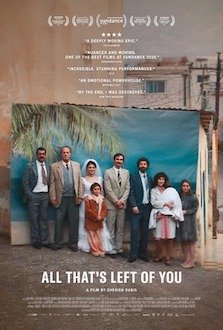
All That's left Of You (2025)

Direction: Cherien Dabis
Country: Germany / Palestine / other

With a narrative spanning three generations—from 1948 to 2022—All That’s Left of You is a tragic drama with unmistakable political undertones, written and directed by Palestinian-American filmmaker Cherien Dabis, who also stars alongside the late Mohammad Bakri and his son Saleh Bakri.

Anchored by deeply convincing characters, the film portrays not only suffering, boundless sorrow, and resilience in the face of war as a daily reality, but also the difficult choices surrounding sensitive issues such as organ donation.

Through a discreet and unschematic approach to staging, Dabis finds emotional power in the tension between historical narrative and family melodrama, embracing a measured lyricism that never feels forced. The film’s greatest strength lies in its faith in humanity as a healing force, an outlook capable of melting even the most cynical hearts. Its storytelling is direct and assured, naturally intertwining collective history with intimate personal experience.

We are all familiar with the countless ways war dehumanizes individuals. Yet here, Dabis refuses to surrender to that inevitability. She never degrades her characters or fetishizes their suffering, choosing instead to foreground their dignity and capacity for hope. The transmission of trauma may be unavoidable, but compassion remains a vital source of relief. In All That’s left Of You, that compassion resonates long after the final scene.

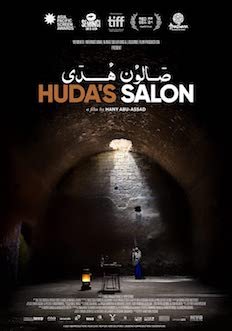
Huda's Salon (2022)

Direction: Hany Abu-Assad
Country: Palestine / Egypt / other 

In this cold political thriller by Palestinian filmmaker Hany Abu-Assad (Paradise Now, 2005; Omar, 2013), two women fight for their lives in a heated Bethlehem under siege. They are Reem (Maisa Abd Elhadi), a young mother trapped in a complicated marriage and forced to betray her own people, and Huda (Manal Awad), the bitter hairdresser who framed her. 

In a first stage, Abu-Assad builds the scenario of a panting thriller, fully captivating. But the film slowly descends the hill of glory to never surprise again. Even if the tension never completely abandons the narrative, the excitement is limited, and we feel like it had no time to settle. There’s also no magnetic presence on the screen, but, on the other hand the plot is never fuzzy and the film makes its point on how society creates monsters and how monsters drag innocent people into the mud. In Huda’s case this was not a matter of political belief, but a forceful desire to retaliate against a cruel ex-husband who made their three sons abandon her. It’s a bit tricky, I know. 

Played in the overwhelming context of the Israeli-Palestinian conflict, the film turns its focus to the different freedoms and “roles” expected from women in the Palestinian society. Although flawed to the point of failing to reach its true potential, and with practically every scene signposted with heaviness, there’s still a pertinent message here demanding reflection.

Omar (2013)

Omar (2013) - Movie Review
Directed by: Hany Abu-Assad
Country: Palestine

Movie Review: “Omar”, the first fully financed film of Palestinian cinema industry, combines skillfully a painful love story and tragedy of war. Hany Abu-Assad, mostly known by the powerful drama/thriller “Paradise Now” dated from 2005, has here a great return after a despicable experience in American soil with “The Courier” in 2012. Omar is deeply committed in the fight for freedom of Palestine, side by side with two childhood friends, Tarek and Amjad. While preparing his first operation against Israeli troops, Omar swap love letters with Tarek’s sister, Nadia, with whom he intends to marry. Things eventually go wrong and Omar is arrested and tricked by Israeli troops, being forced to work as an informant in exchange of freedom. With Nadia in mind, other deceptions will come up, leaving the restless Omar completely alone in a blind alley with no other option than solve the problems by himself. Debutants Adam Bakri and Leem Lubany were very convincing in their performances, complementing Abu-Assad’s assertive direction, in a riveting film that presented traumatized romance, compelling espionage, and striking chases over narrow passages. Balance was maintained throughout all the film, making “Omar” a guaranteed option among other choices of the same subject matter. The film is nominated for best foreign language film by the Academy, and won the special jury prize of ‘Un Certain Regard’ section at Cannes.