
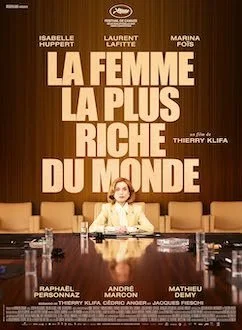
Direction: Thierry Klifa
Country: France
French director and co-writer Thierry Klifa loosely based his film on the scandal surrounding billionaire heiress Liliane Bettencourt, which involved payments to photographer François-Marie Banier and several French government figures.
Isabelle Huppert embodies the heiress under the name Marianne Farrère. Bored with life, she decides to “live” a little more after meeting the vulgar, inconvenient, and arrogant photographer Pierre-Alain Fantin (Laurent Lafitte). Driven by greed and eccentricity, Fantin attempts to turn Marianne against her politician husband, Guy (André Marcon)—a closeted gay man—and their daughter Frédérique (Marina Foïs). The story is loosely narrated by Jérôme Bonjean (Raphaël Personnaz), Marianne’s caring, observant butler.
Enthusiastically oscillating between comedy and drama, The Richest Woman in the World—whose greatest achievement is perhaps living up to its brazen title—grapples with excesses in both plot and duration, provoking nervous laughter and occasional drowsiness without leaving a major impression. However, despite lacking truly effective plot twists, it is meticulously crafted, becoming venomous in the way it portrays a crumbling bourgeoisie. The story, whose details can certainly be admired, is at times frustrating to absorb, yet it carries an undeniable kernel of truth.
Family disruption, obsessive fascination, vile manipulation, and overwhelming lavishness are key elements in this French tragicomedy in the vein of Claude Chabrol, Molière, and Émile Zola. The unstable, operatic marriage of cheeky satire and melodrama would not have worked had the virtuoso duo of Huppert and Lafitte—notably co-stars in Elle (2016) by Paul Verhoeven—not been so committed. Somewhat superficial, Klifa’s film is a ravishing yet emotionally unmoving experience.

Quisque iaculis facilisis lacinia. Mauris euismod pellentesque tellus sit amet mollis.