
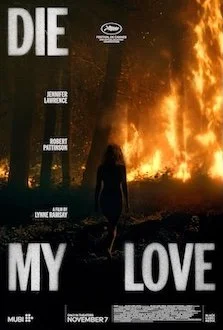
Die My Love (2025)

Direction: Lynne Ramsay
Country: USA 

This raw, startlingly honest effort by Scottish filmmaker Lynne Ramsay (Ratcatcher, 1999; We Need to Talk About Kevin, 2011; You Were Never Really Here, 2017) comes charged with fury, following a young mother—superbly portrayed by Jennifer Lawrence—grappling with mental health struggles and postnatal depression. Set in rural Montana, the story unfolds across two time frames, incorporating flashbacks that gradually deepen our understanding of the character’s fragile psychological state.

Die My Love, both painful and exquisite, carries nuance and complexity even in its seemingly blunt title. It is a small yet shattering adult drama that plunges the viewer into a suffocating, harrowing psychosis that appears to offer no clear way out. Based on the 2012 novel of the same name by Argentine writer Ariana Harwicz, the film was co-produced by Martin Scorsese and co-stars Robert Pattinson, Sissy Spacek, and Nick Nolte.

Creatively shot, Die My Love demonstrates keen visual intelligence in service of a compelling narrative that foregrounds boredom, loneliness, and pervasive unhappiness. It leaves you powerless and contemplative, drawing the audience into a state of distress that mirrors that of its characters. The emotional impact is profound, offering a compassionate look at the unexplainable intricacies of life that can suddenly unravel everything. This film also stands as a remarkable showcase for Lawrence, who delivers an unparalleled performance. She and the rest of the cast maintain complete control over the material, while Ramsay never condescends to or sentimentalizes the subject.

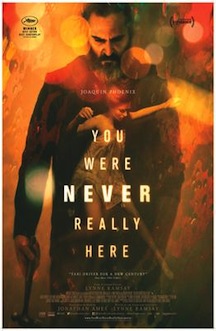
You Were Never Really Here (2018)

you-were-never-really-here-review.jpg

Directed by Lynne Ramsay
Country: USA / other

The dramas of Glasgow-born filmmaker Lynne Ramsay always have something special in addition to its rawness. So far, her short filmography comprehends four features, equal parts heavy and memorable, with the prevailing themes of youth, misfit, family, guilt, and grief. Even if her filmmaking skills and idiosyncratic style were pulsating with life in "Ratcatcher" and "Morvern Callar", her first two works, it was with the disturbing "We Need To Talk About Kevin" that she earned a massive recognition. Now, she returns in big with "You Were Never Really Here", a sunless thriller that exquisitely blends corrosive tension and morbid humor to create gripping scenes of alienation and redemption.

Ms. Ramsay, who wrote the script based on the short story of the same name by Jonathan Ames, summoned Joaquin Phoenix, who, in top form, impersonates an enigmatic, violent, and lethal hitman whose favorite weapon is no pistol nor knife but a ball-peen hammer. Heavily traumatized by an abusive father and a merciless military service, the bearded Joe is very reliable when it comes to ‘wipe out’ a man. After each job, he always goes back to his elderly mother (Judith Roberts), with whom he lives in New York City.

you-were-never-really-here-pic.png

In a new assignment, he vouches to free Nina (Ekaterina Samsonov), the teenage daughter of an important NY Senator, who was abducted to work in a dirty sex business in which major politicians are involved. The operation is dangerous and Joe is perfectly aware it can cost him friends and family, however, he’s not a give-up type guy. With some madness in his eyes and facing each setback with a disarming calmness, the tenacious hitman finds in Nina the force he needs to accomplish the mission and inflict the deserved punishment on the child abusers. 

Immersive and intriguing, the film develops with the tones of a neo-noir but ultimately glows with hope in the end. Even painful when imagined, the violence was never too explicit or extremist, making this revenge tale much more accessible than the intense shockers "Blue Ruin" and "Cold in July", which could easily upset your stomach. At least, the clouded Joe fights for some justice.

Even eschewing plot excesses, Ramsay wouldn’t be so successful without the arresting cinematography by Tom Townend, the brilliant score by Radiohead’s Jonny Greenwood, and the unblemished editing by Joe Bini. They worked well together so that the packaging could look great while thrillingly grim moods were captured through a lens darkly. On another plan, Phoenix makes you enjoy every moment of his sinister role with a quiet assurance.

4.jpeg