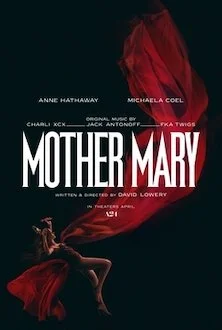
Mother Mary (2026)

Direction: David Lowery
Country: USA

American writer-director David Lowery has given cinephiles plenty of reasons to smile with accomplished features such as Ain’t Them Bodies Saints (2013), A Ghost Story (2017), The Old Man & the Gun (2018), and The Green Knight (2021). Unfortunately, that praise doesn’t extend to Mother Mary, a sloppy psychological drama starring Anne Hathaway and Michaela Coel.

The plot follows the complex relationship between a renowned musical artist (Hathaway) and a fashion designer (Coel), but their personal involvement suddenly takes a ghost-story turn that feels as pretentious as it is ridiculous. Invocations, memories, and resentment are wrapped in a tedious play of imagination and perception, attack and defense, making Mother Mary Lowery’s weakest film to date.

This hopelessly erratic piece of work is too preoccupied with being more than it can possibly be. It never held my interest, dragging me through sequences that lead nowhere and ultimately fail to click.

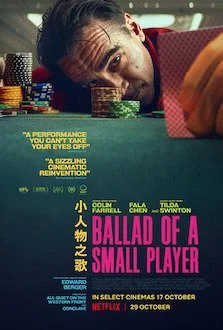
Ballad of a Small Player (2025)

Direction: Edward Berger
Country: USA

From Conclave’s Swiss-Austrian director Edward Berger, Ballad of a Small Player is an adaptation of Lawrence Osborne’s 2014 novel of the same name. Not a groundbreaking work, this oddly psychological gambling drama oscillates between reality and fantasy, carrying a faint but persistent aura of supernatural eeriness.

Colin Farrell stars as Lord Doyle, a ruthless gambler with a battered conscience who heads to the gambling mecca of Macau in a desperate attempt to manage his mounting debts. The situation is increasingly dire, yet the stubbornly optimistic Doyle refuses to surrender, especially after meeting Dao Ming (Fala Chen), a lonely woman working at the casino where he plays. What he cannot escape, however, is Betty Grayson (Tilda Swinton), a private detective and debt collector who knows far too much about his murky past.

Berger is unafraid to take big swings, staging sharp contrasts between moments of crushing despair and others of intoxicating invincibility and ecstasy. Farrell embodies this compulsive risk-taker with such uncompromised honesty that his performance can only be called courageous. Still, some of Doyle’s actions remain deliberately opaque, leaving the viewer suspended in a state of ambiguity that is both intriguing and occasionally exasperating.

Drenched in saturated colors and striking, vivid imagery, and populated by a few characters that verge on the cartoonish, Ballad of a Small Player is far from Berger’s strongest effort. Alongside Conclave (2024), his filmography includes Jack (2014) and All Quiet on the Western Front (2022). Yet this film retains its share of compelling moments. Presented as a nightmarish, old-fashioned character study, it probes the tension-fueled psyche of addiction before drifting toward ideas of redemption and lost love. The film never quite coheres as a whole, and its twists are unlikely to astonish, but Farrell remains a constant source of fascination. Once you surrender to its rhythm, it’s a film that carries you along, unevenly but smoothly.

Killing Faith (2025)

Direction: Ned Crowley
Country: USA

Killing Faith, a supernatural western written, directed, and co-produced by Ned Crowley (Middle Man, 2016), struggles to convince despite solid performances from Guy Pearce, DeWanda Wise, and Bill Pullman, as well as a moody, intriguing premise. It’s a difficult film to champion.

The story follows Dr. Bender (Pearce), an emotionally torn physician who agrees to escort Sarah Worthington (Wise)—a recently freed slave—and her allegedly possessed white daughter (Emily Ford) across the West to seek a reclusive faith healer (Pullman). Their journey is fraught with peril: outlaws, a bizarre family, and an inscrutable Native American chief all cross their path before the trio reaches their mysterious destination.

Sticking to a solid mainstream moviemaking, Crowley crafts his story with darkly comedic touches and a mild supernatural bend. Yet, the film’s eerie tone goes disastrously wrong, marred by a sluggish plot that promises more than it delivers. 

Entering in psycho-religious mode but obliterating any potential nuances or characterization work in the process, Killing Faith’s intriguing concept dissolves into arrhythmic storytelling and monotonous execution. A frustrating case of a film working against its own best ideas.