
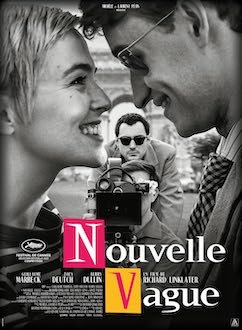
Nouvelle Vague (2025)

Direction: Richard Linklater
Country: France / USA

Acclaimed American filmmaker Richard Linklater (Boyhood; the Before trilogy) ventures into unexpected territory: reconstructing a pivotal moment in film history—the birth of Jean-Luc Godard’s Breathless (1960), and, with it, the rise of the French New Wave and its legends. More interested in the mechanics and behind-the-scenes processes than in traditional drama, Linklater reimagines the past in crisp black-and-white, delivering a wildly entertaining throwback to the ’60s.

Guillaume Marbeck’s radiant performance as Godard—revolutionary, anarchic, unorthodox, and perpetually dismissive of convention—is nothing short of flawless. Zoey Deutch, in her second collaboration with Linklater after Everybody Wants Some!, brings vivid presence to Jean Seberg, while Aubry Dullin channels the charisma and ease of Jean-Paul Belmondo. Together, they infuse the film with a youthful, infectious vitality that makes Nouvelle Vague pulse with energy.

Beautiful, stylish, and memorable, the film captures the joy, urgency, and constant negotiation that define the filmmaking process. Linklater balances complex elements with sharp dialogue and stellar performances, all framed by deftly angled compositions that reflect the unpredictable currents of Godard’s personality—an unconventional filmmaker perched on the cusp of stardom.

Nouvelle Vague arrives as a triumphant recreation of a defining cinematic moment. Steeped in realism and fueled by a palpable love for cinema, it often feels like an exercise in cinephile time travel. And although a few characters drift in without clear purpose, Linklater widens the frame, painting a dazzling portrait of a generation that revolutionized cinema.

The Girl With the Needle (2025)

Direction: Magnus von Horn 
Country: Denmark / Poland / Sweden

The Girl With the Needle is a stark and unflinching period drama, imbued with immense emotional heft. It marks another impressive achievement from acclaimed Swedish filmmaker Magnus von Horn (The Here After, 2015; Sweat, 2020), in his first venture into black-and-white cinema. Inspired by Denmark’s most notorious criminal case—the life of serial killer Dagmar Overbye, who murdered 25 infants—the screenplay, co-written with Line Langebek Knudsen, deliberately avoids a direct biopic. Instead, they introduce Karoline, a fictional young factory worker who becomes pregnant and, through her fateful encounters with the criminal, reflects society’s perception of women in her position. 

The film unfolds with haunting beauty, capturing the profound isolation of its protagonist through restrained yet deeply affecting storytelling. Von Horn constructs a chilling, nightmarish world where loss and despair seep into every frame, leaving little room for hope. His approach, evocative of classic European arthouse cinema, is both subtly exasperating and hypnotically compelling.

The Girl With the Needle is raw, unrelenting, and unforgettable—its emotional and visual impact heightened by masterful staging and an ever-present sense of suffocating tension. Lushly photographed in monochrome, the film is elevated by outstanding performances from Vic Carmen Sonne and Trine Dyrholm, whose portrayals add to its harrowing intensity.

Lola (2023)

Direction: Andrew Legge
Country: Ireland, UK

Nobody can deny that Lola, an avant-garde sci-fi drama in the style of a docu-fiction, is inventive and bold. This experimental Guy Maddin-esque effort by first-time director Andrew Legge is invested in an enigmatic world of found footage, the ability to see the future, controversial decisions in wartime, and a bit of self-discovery. It plays like a feverish funhouse with eclectic music - from art-rock to electronic to the classical music of Elgar - and retro visuals that authenticate the power of film as a medium. 

Shot with several cameras and period lenses, and dreamt in black and white, Lola is the story of two orphaned sisters, Thomasina (Emma Appleton) and Martha (Stefanie Martini), who created LOLA, an advanced machine that can see into the future and intercept its messages. The year is 1949, but the sisters are already enthusiastic fans of David Bowie and Bob Dylan (the music of the future). Almost without notice, they became the secret weapon of the British military intelligence in the war against Germany, but not without a few predicaments that could change the course of history as we know it. 

Story-wise, there’s not much to be happy about it, but even self-indulgent at times, the film has a strange appeal, developing with imagination at an irregular rhythm. These emphatic montages can be very artistic but also gimmicky in its dramatic time travel hallucination. Lola is an unusual picture, insanely evocative and hard to predict.