
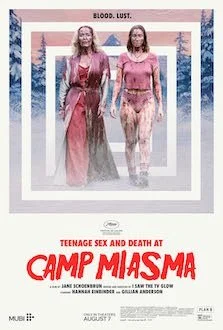
Teenage Sex And Death At Camp Miasma (2026)

Direction: Jane Schoenbrun
Country: USA

In this sex-charged meta-slasher directed by Jane Schoenbrun (We’re All Going to the World’s Fair, 2021; I Saw the TV Glow, 2024), a young female writer-director (Hannah Einbinder), embracing queerness and monstrosity, diligently focuses on the remake of Camp Miasma, a cult horror franchise. Her fascination for the gore and campiness of the original film leads her to its main actress (Gillian Anderson), now a reclusive woman who has made the abandoned, isolated sleepaway camp where the film was shot her home.

Packed with unexplained mysteries and forced dualities, Teenage Sex and Death At Camp Miasma occasionally feels immersive in its mood—its atmosphere satirically beautified by magical A.I. backdrops—but falls short on laughs. It fails to produce the desired disturbance, instead leaving me annoyed by its abundance of slasher clichés rather than genuinely provoking me with something outside the box. Notwithstanding, the film won the Queer Award at Cannes.

I Saw the TV Glow (2024)

Direction: Jane Schoenbrun
Country: USA

Like in her previous feature, We're All Going to the World's Fair (2021), director Jane Schoenbrun blurs the line between reality and fantasy in I Saw the TV Glow, a depressing psychedelic trip filled with mind-inducing eeriness and ambiguity. 

The narrative follows Owen (Justice Smith), a 7th-grade teenager living in the suburbs, who becomes addicted to an obscure TV show called The Pink Opaque. His life gets less empty when he bumps into Maddy Wilson (Brigette Lundy-Paine), another obsessed fan who admits the show feels more real than real life. Suddenly, they realize they have become players in a dangerous game. Everything changes when Maddy leaves without a trace, only to return eight years later with a confused memory and a different notion of time. 

I Saw the TV Glow is aesthetically curious, but its disjointed ideas don’t coalesce into a satisfying whole. Schoenbrun can't avoid force-feeding us metaphors during this infinite fever dream, opting for vague contrivances rather than providing real substance. The underlying tension is constantly present but never packs a wallop. The vision is too narrow for that, transforming this experimental gimmick into a lumbering, misguided mess.

The film, co-produced by Emma Stone, aims for the bizarre but ends up more mind-numbing and emotionally deserted than clever. Paranoia and melancholy swallow aimless phosphorescent kids… is that all you’ve got to offer, Ms. Schoenbrun?