
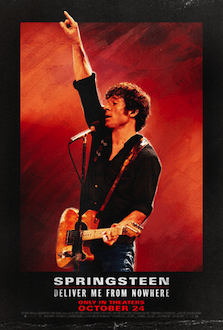
Springsteen: Deliver me From Nowhere (2025)

Direction: Scott Cooper
Country: USA 

Scott Cooper’s adaptation from the book Deliver Me from Nowhere: The Making of Bruce Springteen's Nebraska by Warren Zanes focuses on a very specific period in Springsteen's life, a depressive phase partly motivated by a complicated relationship with an abusive father and a wobbly, reticent romantic affair. Yet, it was a musically creative one, with the musician risking an unorthodox career move that ultimately paid off.

Jeremy Allen White’s much-anticipated turn as Springsteen raises expectations, but neither he nor Cooper ever quite find a rhythm to build upon. The biopic drifts along passively, leaning heavily on Springsteen’s music while failing to draw any real emotional charge from the material. Conventional in approach and stretched well beyond what its thin narrative can sustain, the film remains trapped in bland, repetitive formulas, never daring to push beyond familiar biopic beats.

Cooper’s pacing is leaden, and the film’s narrow focus further limits its scope, sinking into melancholic passages that rarely rise above banality. Enthusiasm is hard to muster, as the overall experience lacks urgency, momentum, and vitality. Despite the suitably retro-flavored cinematography by Cooper’s regular collaborator Masanobu Takayanagi, Springsteen: Deliver Me from Nowhere remains dramatically inert.

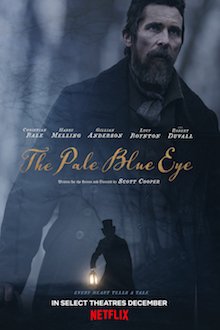
The Pale Blue Eye (2023)

Direction: Scott Cooper
Country: USA 

Based on Louis Bayard's novel, The Pale Blue Eye is an austere mystery thriller shrouded in gothic mist. It's written and directed by Scott Cooper and stars Christian Bale (American Hustle; The Dark Knight; The Fighter) in the role of inspector Augustus Landor - a widowed, alcoholic and tortured veteran assigned to investigate a sordid murder case in the US Military Academy, and Harry Melling (known for several Harry Potter installments) as the morbid young cadet and future writer/poet Edgar Allen Poe. This is the third time that Cooper directs the incredibly adaptable Bale, following Out of the Furnace (2013) and Hostiles (2017). 

With the gloomy mise-en-scene and wintry atmosphere making it even colder, the film, set at the West Point in 1830 New York, tells a macabre story that oozes mysticism and blood. However, if its first part is solid and entertaining, the second is wobbly, marked by a descending curve in the script until crashing in an arguable final twist. 

Although not producing real brilliance, the systematized gothic tones and oppressive heaviness produce a quietly gripping surface. It’s a visually wow-inducing whodunit - with cinematography by Cooper’s regular Masanobu Takayanagi - that feels dour and slow at times.

Antlers (2021)

Direction: Scott Cooper
Country: USA

Produced by Guillermo Del Toro (Pan’s Labyrinth, 2006; The Shape of Water, 2017) and directed by Scott Cooper (Crazy Heart, 2009; Black Mass, 2015), Antlers is an average exercise in horror that mixes indigenous folklore and modern psychology. A solid story would be vital to make the combination work but the director, more inventive in the action and drama genres, doesn’t have one because Antlers has not much to chew on. Unfortunately, a couple of gory scenes doesn’t make for a contrived screenplay and a saturated mood that requires freshness. 

The story, co-written by Cooper, C. Henry Chaisson and Nick Antosca from a short story from the latter, is set in a small mining Oregon town where a series of gruesome deaths occur. The local authorities, represented by Sheriff Paul Meadows (Jesse Plemons), doesn’t have a clue about what could be so ravenous for human flesh. However, the sheriff’s sister, Julia (Keri Russell), a traumatized teacher, suspects that one of her students - the shy Lucas Weaver (Jeremy T. Thomas) - is being abused. In her mind, his junkie father might have something to do with the case. Willing to protect the kid, Julia follows him home, where a dark secret lies hidden.

The film doesn’t have the scope to match its visual craft, and one of its biggest sins is relying on the predictable mechanisms of the horror narrative. Cooper is also unable to deliver real jolts; it’s a pity that, having a wendigo (a demonic creature that originates from Native-American myth) as the source of this fantasy, so little mystery and tension were delivered. I suppose we have seen this too many times before to be frightened.