
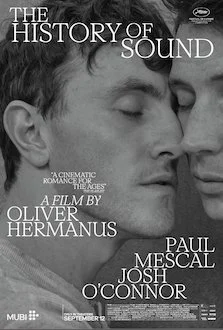
The History of Sound (2025)

Direction: Oliver Hermanus
Country: USA

South African helmer Oliver Hermanus, best known for the dramas Beauty (2011) and Living (2022), returns with The History of Sound, a bittersweet love story between two men bound by their passion for folk music in early 20th-century America. Based on two short stories by screenwriter Ben Shattuck, the film unfolds in sepia hues and dusky textures, yet takes too long to develop, ultimately struggling to find the emotional perspective and dramatic momentum necessary to fully engage.

The story follows Lionel Worthing (Paul Mescal), who leaves his family farm in Kentucky to pursue his dream of becoming a folk singer. At the New England Conservatory in Boston, he meets David White (Josh O'Connor), whose passion lies in collecting folk songs from rural communities. The two are involuntarily separated by World War I, reconnecting in Maine two years later, only to drift apart once more after a year of unanswered letters.

While the narrative remains frustratingly superficial—technically polished yet dramatically inert, most of the film feels trapped in repetition, particularly during the musical interludes, which tend to weaken rather than deepen the emotional current. Hermanus’ direction is elegant and controlled, but also strangely hollow, leaving key emotional threads to dissolve into the surrounding fog. Hermanus and Shattuck clearly approach the material with sincerity, yet the result rarely cuts deeply. Likewise, despite the undeniable talent of Mescal and O’Connor, neither is given the opportunity to deliver truly memorable work here. It’s a disappointing outcome.

Living (2023)

Direction: Oliver Hermanus
Country: UK

Living is an impeccable period drama handled by South African director Oliver Hermanus who, after the well-accepted Moffie (2019), brings us a re-reading of Akira Kurosawa's 1952 masterpiece Ikiru, which he transposes to the post-war London of the same period. 

In the first minutes, especially if you don’t have a reference of the original film, you might be inclined to think that the protagonist is Peter Wakeling (Alex Sharp), a young newcomer who joins his bureaucratic peers at the London County Council for his first day at work. But soon, we realize that the man to follow is his boss, Mr. Rodney Williams (Bill Nighy), a stiff, bored widower who does his job quietly without paying attention to the ones around him. His life suddenly changes  when he is diagnosed with a terminal cancer. From then on, unable to get the attention of his own family, this lifeless man decides to shirk work in order to live what he had never lived before. He confides in two persons: an insomniac bohemian writer (Tom Burke), who takes him partying, and Miss Harris (Aimee Lou Wood), a cheery former employee. 

Living is both inspired and inspiring. It’s also risky as it steps on classic territory. Yet, the core of the film is completely soluble in the contemporary with the exception of the piles of paperwork, which no longer apply to our technological era. 

Although this reflection works as a stinging satire of the bureaucratic mind-set of that time, the film’s best quality remains its emotional honesty. With an appropriate mise en scène and  technicolor photography giving it a deliciously old-fashioned charm, Living is a tastefully poignant story of deep human emotion wrapped up in a retro British wall covering. It’s sad, but in its awakening consciousness, it reminds us all that it’s never too late to embrace life.